Followers

Showing posts with label Garrison 20mm. Show all posts

Monday, 7 January 2013

Beastly Hun

More snaps kindly supplied by Rob. These show Minifigs S range one-piece castings (or "Onesies" as we should probably call them nowadays) of a Hun archer and a Byzantine lancer. The Garrison 20mm cavalryman (still available from Garrison, hurry, hurry) is in for scale.


Tuesday, 18 September 2012

Frosty Punics


(Foreground: Roman heavy cavalry forms the filling in a sandwich of Carthaginian horse, while in the middleground Hannibal leads his noble cavalry in a charge. Behind them the lines of the Roman legions watch on)

Back in the olden days wargamers didn’t get too hung up about the historical accuracy of their miniatures. When Charles Grant needed Sumerian chariots for his re-fight of Kadesh he used a load of vehicles culled from Celtic, Indian and Persian armies. For his Punic Wars era Battle of the Po, Terry Wise meanwhile opted for Airfix Roman legions, with Hannibal boasting Numidian cavalry from the same firm’s Red Indian set.

The second of our wargame weekend battles was something of a homage to the late and much lamented  Wise (All the gamers round the table had bought figures from the great man over the years), pitting a Carthaginian army against one made up of Garrison 20mm Imperial Roman legion and auxiliaries.

For the purposes of the game all the Romans were counted as Princeps.
 
 
(Carthaginian battle lines)
 

Carthaginians


Leaders:

Hannibal (Plus 2)

Marhabal (Plus 1)

 
3 x Libyan/Phoenician spearmen

2 x Spanish Scutari

 
4 x Gallic warbands

4 x Balearic Slingers

2 x Spanish Javelins


1 x Carthaginian Noble Cavalry (elite)

2 x Phoenician Cavalry

1 x Spanish light cavalry

2 x Numidian light cavalry

3 x Elephants

Romans


Leaders

Fabius (plus one)

Convolvulus (plus one)

14 x Roman Legions (elite) – fight as princeps.

2 x Ligurian Archers

2 x Samnian javelins

2 x Roman Heavy Cavalry

2 x Roman Light Cavalry


(Light Cavalry skirmish, while the elephants rumble forwards)

Action!


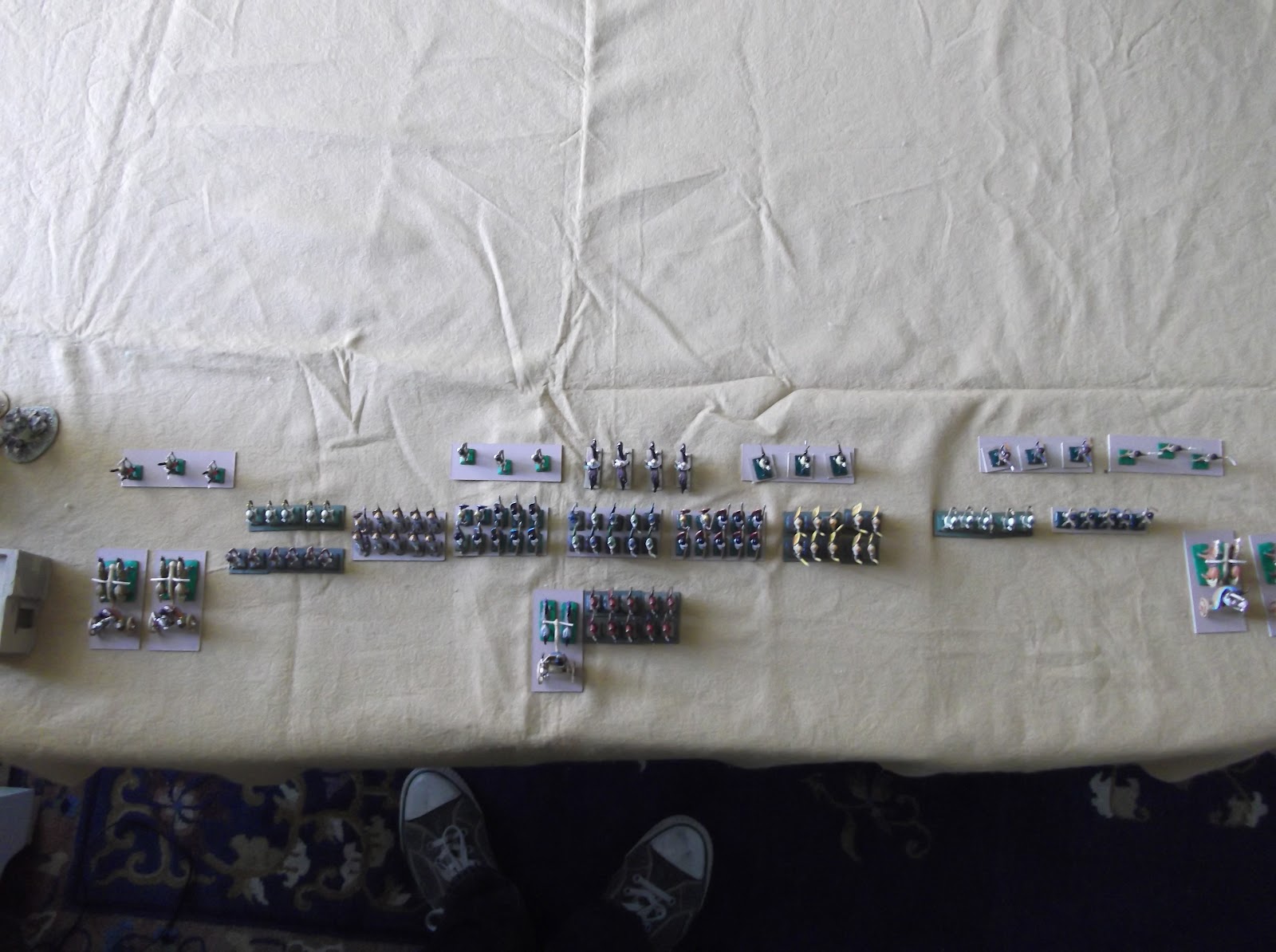
With Stephen called away by work commitments the table was expanded to 6x4. Old John and Clive took charge of the North Africans, while Richard and I commanded the home army.

The formations of the two battlelines were predictable (as yet Ancient wargaming has not embraced the equivalent of the total football revolution) with both armies matching up like for like. For the Romans the key to the battle was clearly to fend off the Carthaginians’ superior cavalry for as long as possible, trust that the elephants would prove to be more bluster than substance, and then destroy the enemy centre with their better disciplined and more powerful infantry.

The Carthaginians meanwhile hoped quickly to dispose of the outnumbered Latin horse, and turn in on the flanks of the infantry while it was engaged in beating off the elephants.

The opening rounds of action saw the Roman heavy cavalry charging out to meet the Carthaginian heavy horse in the hope of knocking one unit out of the action and evening up the odds. Sadly the Carthaginian noble horse, commanded by the great man himself, were not amenable to this scheme, and the Romans quickly found themselves engaged in a melee in which they were outnumbered 3:2.

On the opposite flank the Roman light horse rode out to meet their Numidian and Spanish counterparts and then began a slow retreat in front of them, the aim being to keep things on that flank as indecisive as possible for as long as possible.

In the centre the elephants rumbled forwards with Spanish skirmishers protecting them from missile fire and doing their best to disperse the Roman auxiliary lights.
 
(The final moments)

Initially all seemed to be going well for Hannibal. The Roman heavy cavalry was battered and fell back, while the Numidians and Spanish destroyed one unit of light cavalry with ease and now enjoyed a 3:1 advantage over the other.  The outnumbered Roman light troops also took a hammering and soon only one unit remained.

At this point, however, the favour of the dice Gods turned in favour of the Romans. The remaining light cavalry and light infantry held on, despite both teetering on the verge of destruction, while the remaining Roman heavy cavalry unit also refused to give way. In the centre the elephants were now within charge move, but in the morale tests one of the great beasts panicked and charged back towards his own table edge. The Carthaginian commanders had sensibly left a gap behind the elephants for just such and eventuality and no harm was done. The remaining two pachyderms did charge home. The Legion were not awed by their trumpeting however and stood their ground. In the ensuing melee the elephants failed to make any headway and soon, disheartened and bloodied by pila and swords, turned and fled.

If the Romans though victory was now secure they were wrong. For at more or less the same moment as the elephants ran, their own cavalrymen finally gave up and fled, leaving the flanks of the legionaries open to attack.

However, in a masterstroke of strategy the Roman commanders had held four units of Legion in reserve behind the main battle line. These units were now able to move into action against the Carthaginian horsemen.

As the heavy Carthaginian infantry and Gaulish allies crashed into the Romans the outcome was still in the balance. But after several rounds of bloody hand-to-hand fighting the superior discipline of the Legion proved decisive.
 

Hannibal, who had cheated death in a positively Alexander-like manner (The Roman generals were not nearly so lucky) galloped off with the remainder of his cavalry leaving the bloodied field to the Romans.

This was a cracking little battle, which went to the wire, producing much joy and laughter amongst the participants. What more can you ask for?

Monday, 17 September 2012

Eagle In The Snow Part Deux


(Garrison 20mm Imperial Romans in action: auxiliaries to the fore)

For the wargame weekend with Old John and Richard I set up a table with winter terrain on it which could be used for anything from ancients through to Russian Civil War and quickly wrote up three scenarios for the former. My plan was to start with a game in which Alexander, leading a fast moving task force, cornered some Persians in the mountains of Bactria, follow it with a Terry Wise-inspired battle in the Abruzzo involving Hannibal and some unhistorical Roman legions and finish with a more traditional clash between the Imperial Romans and the local Brigantes. Since Friday night also drew Clive and Stephen into the cramped environs of the Longuelade bivouac the table for this first game was small - just four feet by four feet - and for reasons that I can't now recall amongst all the yelling we began with the Celts and Romans.

Richard and Stephen commanded the Imperialist invaders determined to impose their alien way of life on the natives, while Old John and I took charge of the noble freedom fighters. Clive Norman was the war artist/umpire.

The scenario was simple:
The Romans had thrown a pontoon bridge across the Tyne. Some of their army had crossed to the north bank, while the rest would arrive at some point in the future. Celtic opposition was likewise arrived or arriving. All this was determined by dice throws, which - predictably - didn't seem to go well for the Brigantes.


Romans


Leaders

Maximus (plus 2)

Sixtus (plus 1)

8 x Legions (elite)

6 x Auxiliary spearmen

4 x Roman auxiliary slingers

2 x Roman Auxiliary light Cavalry

2 x Bolt throwers


 (Stephen points out the error of his ways to Old John)

Brigantes


Leaders:

Venutius (plus 1)

Vellocatus (plus 1)

14 x Close order warbands

4 x Light Javelins

2 x heavy cavalry

6 x chariots


(Old John issues directions to an S range chariot as Garrison 20mm Roman slingers attempt to knobble the horses)
 
The ensuing action was confused. Suffice it to say here that the Brigantes chariots capered about the place looking impressive andheroically manly but achieving very little. The Celtic cavalry met with more success and drove the Roman light horsemen back across the bridge. The Roman infantry was made of sterner stuff and easily dealt with the roaring warbands, who retreated back towards what is now Wark.

Sunday, 29 July 2012

Mind The Gap, Please! - Action in the Hills of Bogi


                                                   Battle of Figment Gap


(Assyrian commander, Sha'ol Shamanisar - S range chariot with Garrison 20mm and S range crew- behind Garrison 20mm Assyrian infantry. S Range Assyrian medium infantry to the left, heavy archers from the same source on the right)

Originally I had been intending to fight this action with Stephen, but he was unable to take part due to work commitments and so I played it as a solo game instead. The Assyrian posture was a defensive one, so that seemed a straightforward enough, especially since my right hand rarely knows what my left is doing in any circumstance.

In my dual role as commander of both armies I set the Assyrians up first, a strong line of heavy infantry, interspersed with the close order archers occupied the centre, the slingers and javelins were placed on both flanks, on the hillsides above the Gap with the Lancers - potentially the Host of Ashur's most potent weapon on the left behind a screen of skirmishers. The Assyrian general attached himself to his central infantry regiment, Margash. It was decsion that was to have dramatic consequences.


(Buzzard cam view of the Assyrian battle lines, heavy troops occupying the Figment gap)

Tuckekhamen meanwhile arranged his battle line much as he had at the Apocryphal Well with chariots and skirmishers on both flanks. The centre was also screened by skirmishers, with the horse archers of Koth in the middle. Close order missile units formed to the left and right of centre. Mindful that his own melee troops were inferior to those of the enemy Tuckekahmen intended to wear them down with missile fire before launching his main assault. The general himself had attached himself to the red-uniformed Set infantry, held in reserve to deal with any breakthrough by the Assyrian cavalry.

(And did these feet in ancient times...The Egyptian battle lines - with Converse Jack Purcell's to the rear)

 
Since the Assyrians were cast as the defenders, the Egyptians moved first. The entire line advanced,  the horse archers of Koth trotting forward within bow range and letting loose a long range volley of arrows at Shalmaniser and the Margash infantry. Unsurprisingly no damage was done and behind their vast shields and even vaster beards the Assyrians guffawed uproariously at the puny ponies and weedy arrows of their foe.                                                                                                                   


(Egyptian battle lines. S range close order infantry and PB range archers)

In response to the Egyptian move the Arvad archers fired back at the Koth cavalry causing two hits to the novice horsemen.


(The horse archers. Such newbies to the wargames table they didn't even have bases, they were, nevertheless, to play a fateful part in proceedings)

On move two the Egyptian advance continued the horse archers now moving boldly into close range of the Assyrian lines to add an extra dice in their firing roll. With the general attached it required 16 or more to score a hit on the armoured infantry. The dice were cast: 9, 11, 17, 18. Two hits. "Now," I said to myself as I went to draw the card to see if the general had been harmed, "Wouldn't it be unfortunate if he died this early in the battle". The card was flipped. Jack of Hearts. Shalmanisar followed his predecessor in returning to the bosom of Anu, having issued just one order to one unit.

In previous battles the death of the commander would have been unfortunate but only a little debilitating. However, with the Army Funk Revelator in operation the gauge immediately moved 4 places against the Assyrians. With the Egytian chariots now in range and peppering the javelinmen on both flanks, and the Egyptians skirmishing archers also letting ,the rearguard were already wobbling.

The return fire of the Kish slingers did something to restore Assyrian equilibrium - they had a 100% success rate against the Nubian bowmen, inflicting four hits on the leaopardskin-sporting Africans


(Another one bites the dust...The card draw that saw one more Assyrian commander fatally skewered by Egyptian arrows. The horse archers who dealt the blow can be seen at the top of the picture.)

On move three the Egyptian chariots came fully into the action, and along with the fire of the skirmishing archers dealt a fearful revenge pasting to the slingers of Kish who took six hits during the turn. The horse archers of Koth, who had been severely mauled withdrew to the right rear of the line to avoid destruction.


The Assyrian response - driven perhaps by grief and panic - was misjudged. Sensing that the battle was slipping from their grasp the Arbela Lancers charged down from the hill at the Egyptian slingers. A charge morale test saw the slingers taking a hit, but scampering away out of range. Unfortunately for the horsemen, when the tape measure was brought out it revealed that even with their charge bonus they would fall 3cms short of their second target - the close order Hathor archers. This left them isolated and exposed. All around them the Egyptian missile troops flexed their bows and slipped stones into their slings.

On move four hell broke loose for the forces of Pelmaneser. With the horse archers of Koth circling to their flank, the lancers were subjected to a wave of missile attacks. The horse archers fired first. No hits. The slingers fired next. One hit. Next the Amuket archers unleashed a volley. Two hits. The Assyrian horsemen crossed their fingers. There was just one unit left to fire - the bowmen of Hathor. If they could survive then it would be their turn to wreak the sort of  havoc their brethren had inflicted earlier in the campaign. The Egyptians took aim. At close range they were rolling five dice. They needed scores of 16 or more to hit. The D20s rumbled across the desert sand, stopped. 13, 17, 19,17, 19. The lancers were galled beyond endurance. They turned tale and fled. A great cheer went up from the Egyptian ranks, for now the Revelator moved another three places against the Assyrians inflicting a hit on every unit in their army. This proved too much for the slingers of Kish - already on six hits - and they joined the horsemen in running off to the north. The Revelator slid another two places. And the Egyptian fire has not finished yet. On the far right of the Assyrian line the Lullabi javelins took more than they could stand and broke. The Revelator moved up to ten. Another hit inflicted on the Assyrian line. Units all along it were now in a parlous condition. A dramatic response was needed. Brilliant archery from the bowmen of Calah, who struck home with five hits on the Osiris chariot squadron, showed the spirit required, but the other Assyrian units could not repeat their success. The move ended with Egypt ascendant.

(Chariots in operation between the rival battle lines. They have taken a fair hammering, but for the Assyrians it was all too little too late.)

Since it is only move five, Tuckekahmen is aware that all he need do now to ensure victory is withdraw his battered units, and send forward the fresher missile troops to unpick the Assyrian line at leisure. He therefore calls on the enemy to lay down their weapons. A dice is thrown to see how they respond. An unquivocable "No".

Alas the bloodshed that follows is too predictable to be detailed here.

Friday, 20 July 2012

Nectanebo Points


Old John from 20mm Nostalgic Revival and Richard from Vintage 20Mil are coming up for a wargames weekend in early September. Hopefully we'll get to fight a couple of large battles. The first will be the clash between Antigonus and Eumenes at Paraetecene in 317BC. Pondering what the second will be has occupied many hours of dog walking.

Initially I had thought of some equivalent of Grant's Mandubian Hills scenario in which Germans were replaced by Galatians, Romans by Seleucids. I imagined the latter force being made up of mercenary hoplites and peltasts, supplemented by Persian cavalry and Syrian archers. Such a scheme would have meant diverting from my attempts to finish the Egyptian Army, however, and turning instead to painting Gaulish chariots. Since one thing tends to lead to another when it comes to painting figures I could foresee that such a step would mean not getting back to the Egyptians until 2022, probably with the Franco-Austrian War in between.

It was fortunate then, that the other day, I picked my copy of HW Parke's Greek Mercenary Soldiers (1933) off the shelf with a view to looking up something else entirely, and found myself reading the details of - or rather lack of them - Artaxerxes Ochus' ill-fated first attempt to reconquer Egypt, a campaign that occurred some time around 350BC. The fighting apprently went on for a year and culminated in a crushing Persian defeat, but - Diodorus being reticent on the topic - not much is known about what actually happened.

Parke surmises the following:-

a) That the Egyptian Army of King Nectanebo II featured a large number of Greek mercenaries, including contingents commanded by Diophantus of Athens, Lamias the Spartan and Mentor of Rhodes

b) That the Persian Army in all likelihood did not include Greeks - Artaxerxes having attempted to secure his position as Emperor by disbanding the Greek mercenary contingents of his satraps to minimise the potential for revolt.


This is not much to go on, which from my point of view is a distinct advantage. I propose a battle in which the Egyptian Army of the 30th Dynasty supplemented by Greek mercenary hoplites, takes on an army of Persians, Medes and assorted satrapies on the banks of the Nile.

Any suggestions for the troop types employed in the Egyptian Army of this period gratefully recived - though only if they are something I already have, obviously.


Monday, 25 June 2012

The Anabasis of Longuelade


The Longuelade household is moving quarters this week, a march of about a mile, but one which will doubtless involve many lengthy telephone skirmishes with the likes of BT, npower and TV licensing. Normal service - internet connection permitting - will resume on 4th July.

The above photo features one of Rob's Garrison 20mm Gaulish chieftains alongside a rather nice old Wargames Foundry dog. I should point out that the dog is an old English sheepdog, a breed that did not actual appear until Elizabethan times (when it was called a bobtail, incidentally). The photo therefore presents the sort of glaring historical error that would once have kept the pages of Military Modelling going for months...

Wednesday, 20 June 2012

Gaugamela - Part Three, Blood and Scythes.


(Pbs Macedonian successor phlangites)

This was another of our big Christmas battles, fought across a table measuring 13 feet by 6 feet. On this occasion Kevin White and Paul Jackson joined the usual suspects. Along with Stephen they commanded the Macedonians.  Clive and I once again took charge of the forces of the Lord of Asia.

In the two previous large battles – Plataea and the Granicus - I'd felt the Persians had a reasonable chance of success. For this one, however, I was far from confident. The make-up of the Persian force was eccentric and seemed to reflect Darius' mounting desperation. 

In the Baron De Bazancourt’s witty 19th Century treatise on fencing “Secrets of the Sword”, the author observes that, “A gentleman should always be aware of the fine line that divides those acts which are bold and those that are merely rash”. Boldness – the Baron counsels sagely - is the province of the decisive and the brave, rashness stems at best from a lack of confidence in one’s own abilities, and at worst from cowardice. These words seem particularly applicable when considering the widely differing temperaments of Alexander and Darius. The latter, you feel, is forever leaping erratically forward, sword flailing, eyes firmly shut.


(Persian Cavalry - Pbs Dahae horse archers, S Range Assyrian horse archers and two units of Garrison 20mm heavy cavalry)
In the immediate aftermath of the battle, Stephen gave the following excellent account of the action:

“For our Christmas Ancient's big battle Harry laid on an incredible spectacle of 3 elephants, 20 chariots, 464 cavalry and 686 infantry. Once again he generously let
me, and those who arrived with me, command the Macedonians who had won
every historic engagement we had recreated.

This was perhaps the most convincing display of Macedonian might/luck/destiny so far.


(Garrison 20mm Egyptian cavalry, clash with Greek cavalry from the same maker. In the background is a unit of PBs Thessalians) 
 As Alexander I feared the unknown effects of all the scythed chariots and the elephants because we had not faced them before and I knew that the Persian cavalry were highly manoeuvrable - especially those horse archers.

I gave Kevin White (Army Padre, attached to Royal Artillery, Albermarle Barracks) command of the infantry centre - he had to get the phalangites forward as quickly as he could, use his lights to whittle down the threat from the chariots and elephants, and keep an eye on the baggage behind him!

Paul Jackson (Lecturer in War Studies at Birmingham University) said he enjoyed improvisation, so got the weak left wing whose task was to hang on in there while the battle was won elsewhere - this he did indomitably which probably ruined the
Persians best chance of success.

On the right, which had the elite Companions and Hypaspists, I hoped to stay out of trouble as long as possible and act as a reserve to the big infantry attack in case the Persian gimmick weapons blunted their assault.


 (An overall view of the action. Scythed chariots and Indian elephants rumble forwards, as Greek hoplites preapre to defend the baggage and to the rear Darius looks on with growing nervousness)

This scheme soon had to be abandoned, however, for a plan that was likely more to the historical Alexander’s taste.

Finding himself outflanked by the Persian left wing, Alexander chose to ignore those furthest to his right and attack diagonally through the joint between the left and centre and head straight for Darius.

The Companions' charge proved unstoppable. Suffering barely a casualty they rode through everything in their path, leaving a wake of destruction behind them. They must have appeared to the Persians as invulnerable and invincible. Since they were barely delayed by their opponents those enemy units aiming to catch them in the rear and overwhelm them with weight of numbers simply could not catch up to do so.


(Scythed chariots decide to avoid the spearpoints of the phalanx and swerve off to the side, while in the distance Alexander begins his bold charge towards the Persian king)

The battle was almost a historical recreation. The honourable exception being the behaviour of the heroic - or desperate – Darius. On seeing the Companions getting nearer and nearer, the Great King opted not to flee but to join the nobles in his cavalry and attack the nearest regiment of the phalanx head on. He died a glorious death and his passing signalled the collapse of the Persian army.

It felt less like a wargame and more like a statement by the shade of Alexander himself. The rules, Harry's own, recreated the events of that fateful day from the uselessness of the scythed chariots to the shock and awe of Alexander at the head of the Companions. On previous occasions the Companions have taken a battering and Alexander survived purely by being a jammy so and so, but this time they were simply the proverbial 'hot knife through butter' and butter does the knife little harm.


(The Hand of the Fates! Alexander has cut his way through several Persian cavalry units and now just a phalanx of Greek mercenaries stands between him and his prize - the Persian King)


(Elephants on the rampage. They have broken through a phalanx which has also been hit in the flank by Garrison 20mm Assyrian cavalry. Unfortunately for the Persians the scythed chariots are heading in the wrong direction....)

Apart from Paul's valiant defence on the left the Macedonian generals had little to do than to let their troops get on with it - frustrating all the abilities of the Persian generals' expertise and courage.”


(Pbs Thessalians do their bit to hold up the Persian right wing, in this case some S Range assyrian lancers)
Stephen's account sums up the action very well. As one of the Persian commanders I always felt there was only a vague chance of winning. That would come if we could get a spot of luck with the dice and hold the Companions for a move or two which would have allowed us to make the most of our advantage in numbers. We had managed this in the Granicus refight and gave the Macedonian a severe mauling. This time around we were not so fortunate.

One major problem was the extreme length of our front. At Granicus, on a narrower table, we had been forced to deploy a reserve. This time around we strung out cavalry out along the entire table length. When Alexander drove at the point where the left wing met the centre, he effectively cut a large portion of our army adrift. With the Companions heading straight for Darius, the Persian left, which had designs on enveloping the phalangites, was forced instead to break off from that intention and instead pursue Alexander in a hopeless attempt to save the king, their progress severely hindered by the decimated Persian units the Macedonians left in their wake.

Our other problem was the make-up of our army, which, being nearly all cavalry, had to win the battle before the phalanx could rumble into contact with our puny centre.
As historically the scythed chariots had little impact on events. Most veered off to left or right, avoiding contact with the spear points of the phalanx. The elephants were more effective, doing major damage to one phalanx before running out of steam, but they were too few in numbers to have any major effect.

The re-fight gave me a fresh appreciation of the brilliance of Alexander's troop dispositions - the second line of hoplites effectively preventing any outflanking Persian cavalry from attacking the rear of the advancing phalanx.


(A rare moment of glory for the Persians....Indian elephants smash the phalanx, though the dice indicate they themselves have been severely damaged)

In summary:  a wargame that ranked high in terms of spectacle, but relatively low on the scale of excitement.

Gaugamela Two - Special Rules For The Battle


(A Garrison 20mm Philotas leads forward Garrison 20mm Companions, as the phalanx crunches into Darius' Greek mercenaries)

General

Macedonians move first

Individual command figures add plus one to all charge morale throws and 1D20 to combat dice roles. Alexander adds 2. This may be combined with other Macedonian leaders (for example with Kleitos and Alexander attached the Royal Companions would add 3D20 in melee)

Persian unit movement. All close order cavalry units can move each turn. Other Persian and allied units must throw above the number of hits they have suffered on a D6 in order to move.

Macedonian Baggage

Alexander had to detail some of his force to guard the baggage, this seems to have fallen to the Thracian peltasts who later fought off an incursion by Persian cavalry intent on rescuing the female members of the royal household who had been captured at Issus. Should the Persians get amongst the baggage and remain there for one full turn then all Macedonian units suffer 1 hit (this represents the damage to their morale of seeing all their hard won plunder being ransacked)


(Garrison 20mm figure of Mazaros leads forward some Garrison 20mm Egyptian heavy cavalry, the latter are figures converted and cast by Rob - and very nice they are too)

Darius

Alexander was determined to capture or kill the Persian king. If he succeeds the battle ends at the conclusion of any current melees in a Macedonian victory. If Darius flees the table to avoid Alexander then all Persian units suffer 2 hits immediately.


(Chariots breaking through a unit of Pbs Agrianes)

Scythed Chariots


The tactics with these seems to have been for the charioteer to gallop towards the enemy and then jump off at the last minute. To simulate this:


Move charging chariot to within 4cm of the enemy unit it is charging.

Throw a D6

Score 1 = Chariot halts short of enemy lines. Remove model

Score 2, 3 = Chariot turns 90 degrees to the left

Score 4, 5 = Chariot turns 90 degrees to the right

Score 6 = Chariot continues straight ahead


If a chariot does not halt throw 4 x D6 to see how far it moves. If the chariot makes contact with any close order unit, foe or friend, throw a D20 for hit. Light units simply part to let it pass through.


Normal additions apply, i.e. a chariot charging into a units flank will add 2 x D20

A chariot cuts straight through any unit it contacts and carries on for its full move distance throwing for any other units it contacts as before. Once it completes its move the model is removed.

Any unit contacted by a chariot must halt for one turn whether it has suffered casualties or not.

Chariots may be eliminated by missile fire in the usual way. A score of 10 or more is required to hit. If attacked or charged chariots will countercharge as above.


(Scythed - well you have to imagine the scythes - chariots have passed through the PBs Cretans and approach the phalanx, which is menaced on the flank by S range Assyrian lancers. A mix of metal and plastic vehicles painted by Ray McGarry)

Tomorrow - Action!

Tuesday, 19 June 2012

Gaugamela - Part One, set up and forces.


(Persian battle lines. PBs Dahae horse archers in the foreground. S range Assyrian horse archers just beyond them)

On an autumn afternoon in AD331, on a featureless plain that had been specially flattened to allow full use of his chariots and cavalry, Darius the Great King awaited the arrival of Alexander and the Macedonians.

Having tired of the pitiful performance of his native foot soldiers, Darius had more or less abandoned infantry altogether, focusing instead on the more reliable and courageous horsemen from the North and East of his Empire. In his battle line were mounted Bactrians, Scythians, Armenians, Cappadocians, Hykranians, Parthians and Indians, to the front of which were arranged hundreds of scythed chariots and a small group of elephants.


A few days before Darius had made one final attempt to bring the war to a peaceful conclusion, offering the Macedonian invader all the land west of the Euphrates, 30,000 gold talents and the hand of one of his daughters in marriage. The offer had been summarily rejected. “Asia can no more support two monarchs, than the earth could survive with two suns,” Alexander had told the Persian envoys. If the king wanted to hold onto his crown, he would have to fight.


(The Macedonian battle lines from Alexander's left. Garrison 20mm Greek light cavalry and PBs mercenary peltasts in the foreground)

When Alexander arrived at the crest of a low hill that looked across to the Persian battle line he may, momentarily, have wondered if he had made the correct decision. The fading sun reflected off thousands of spear points and from the scale armour of horses and men. Darius’ cavalry outnumbered his own by at least 4-to-1.

Instead of launching an immediate attack as he had at the Granicus and Issus, Alexander spent the rest of the day reconnoitring the battlefield, then retired to his tent to draw up his plans….
The exact make-up of the Persian Army is – predictably - open to doubt. I have opted to take Peter Green as my main guide mainly because his interpretation is likely to give the best wargame.

(The Macedonian centre. PBs phalangites with Cretan archers and Agrianina javelins skirmishing ahead. Behind them Garrison 20mm Greek hoplites guard the baggage)
 
Macedonian Army

6 x 40 Phlangites                                 240 figs
2 x 24 Hypaspists                                48 figs
3 x 20 Peltasts                                      60 figs
2 x 12 Cretan archers                           24 figs
1 x 12 Macedonian archers                  12 figs
2 x12 Agrianian javelins                     24 figs
1 x 12 Macedonian Javelins               12 figs

6 x 24 Greek Mercenary Hoplites         144figs
2 x 16 Companions                               32 figs
4 x 16 Greek Light cavalry                   64 figs
1 x 16 Thracian cavalry                        16 figs

Total:   544 infantry
           112 cavalry

(Persian battle lines from Darius' left. The cavalry stretched from one end of the 13 foot long table to the other, though, as we shall see, this long frontage proved problematic for the Persians.)

Persian Army

1 x 40 Immortals                                        40 figs
2 x 24 Mercenary Hoplites                        48 figs
2 x 20 Mardian archers                              40 figs
2 x 12 Light archers                                   24 figs

5 x 16 Horse Archers                                    80 figs
5 x 16 Light Cavalry                                    80 figs
7 x 16 Heavy cavalry                                   112figs

3 x Indian elephants and crew

20 x Scythed chariots and crew                            

Total: 142 Infantry
           352 Cavalry
             20 Chariots
              3 Elephants
(Pbs Indian cavalry and S range Immortals)

Monday, 18 June 2012

Granicus - More Images

While packing I discovered a CD of snaps of The Granicus taken by Persian co-commander Clive Norman.


(Macedonian Phalanx, rear protected by Thracians)


(Pbs Companions clash with Garrison 20mm Persian cavalry on banks of Bellona stream)


(Pbs Thracians with Garrison 20mm Macedonian commander prepare to test the theory that S Range Assyrians "Don't like it up ,em")


(Mass melees. Companions wade into Persian cavalry and hoplites; Persian cavalry clash with phalangites, Thessalians gallop off the edge of the frame and Cretans lurk menacingly)


 (Manfredates, one of the Persians' more astute commanders).

Another Phrygian (Mess You Gotten Me Into)


The Longuelade household is currently in the process of moving to more permanent quarters. Paints and brushes were packed away yesterday, but I did find a couple of hours beforehand to paint this Garrison 20mm Phrygian spearman. He's a very nice figure, drawn from Saxtorph and Funcken. I'll have a unit of 40 of them at some point.

Tuesday, 12 June 2012

Moustachioed Nemesis

Knocked out by a man named Posinov from St Petersburg with facial hair a bit like these Garrison 20mm fellows.

Friday, 8 June 2012

Granicus - Action Stations!


(Right wing of the Macedonian army, Alexander galloping along next to some Minifig PBs Companions. Behind them are two more regiments of Companions, these by Garrison 20mm. Beyond them the PBs Cretans and Hypaspists and the phalanxes)

Our action was fought over a table measuring ten feet by seven with the river running diagonally across it starting two feet in from the Persian table edge and ending two feet in from that of the Macedonians. The Granicus – said to be knee deep on the day of the battle - had no effect on cavalry movement but slowed and disrupted the phalanx which fought less effectively while wading through the water.

Alexander began the game in column of march. His forces consisted on 6 x 40 fig Phalanx, 3 x 24 fig Hypaspists, 2 x 12 Cretan archers, 2 x 12 Agrianian javelins, 3 x 20 Thracian and other peltasts; 3 x 16 Companion cavalry, 2 x 16 Greek allied cavalry and a 16 figure unit of Thracian prodromoi: a total of 420 infantry and 96 cavalry.

(Macedonian left, Pbs Thessalians and Garrison 20mm Greek light cavalry)
Opposing him was a Persian army of 20 x 16 cavalry, 8 x 24 Greek mercenary hoplites and 4 x 12 Greek light troops, a total of 240 infantry and 320 cavalry. The Persian cavalry, a mix of heavy, medium, light and horse archers, lined the river bank, while the hoplites formed up a distance behind them pretty much as in the actual battle. The Persian commanders – myself and Clive Norman – actually found we had too many cavalry to cram in on the ten foot front available and held 4 units back in reserve.

The initial moves saw Alexander – Stephen Caddy aided by The Old Metal Detector himself - deploying from column, the Companions taking up a position on the right flank, the prodromoi and light troops scouting ahead of the slowly advancing phalanx and the peltasts screening the phlangites vulnerable left flank. Surprisingly Alexander also opted to send the Greek allied cavalry over to the right to join the Companions. A massive “hook” was clearly the plan.

(Some more of Memnon's mercenaries. Garrison 20mm figures)
The Persians attempted to disrupt the Macedonian deployment by sending 5 units of horse archers across the river. Those on the Persian left were swiftly dealt with by the Companions but not before a well aimed arrow from one of the Sakae horseman had pierced Philotas, killing him instantly. On the right the horse archers faired altogether better, lurking dangerously and causing gradual but mounting damage to the peltasts and phalanx.

The Companions and the Prodromoi quickly reached the Granicus and soon were battering the Persian defenders. Unit after unit of the Great King’s cavalry broke and fled before the onslaught. Arsites was killed in a melee, so too was Spithridates, while Memnon of Rhodes was swept from the field along with his Trodean horsemen. After an hour of fighting it looked indeed as if the end would very soon be in sight for Mithrobarzanes, the last remaining of the Persian nobles.

(The Royal Companions cross the Granicus despite an oblique attack by some Egyptian horse, pecking fire from some Dahae horse archers and the arrival of some Greek mercenary light cavalry)

At this point, however, the sweeping success of the Macedonian cavalry drew it into difficulties. Having driven all before them Alexander and the Royal Companions suddenly found themselves isolated from their compatriots. The Persians threw in their cavalry reserves (ie the ones we couldn’t fit in the line) supported by several hoplite units and soon the young king was battling for his life. An attempt by the Prodromoi to come to his rescue ended with them being caught in flank and rear and destroyed. The Royal Companions too eventually disintegrated, but Alexander miraculously survived (every time a unit with a leader attached is hit we turn a playing card – a red picture card results in the leader being killed. During the struggle Alexander turned up a 10 of diamonds, an ace of hearts and an ace of diamonds. As in the real battle the great man seemed to live a charmed existence). Alone in a mass of swirling Persian cavalry he was rescued by the counter attacking Companions lead by Black Kleitos who threw back the Persian horse and Greek mercenaries. Tragically in saving his king the brave Kleitos himself was killed (though at east that saved him from being skewered by a drunk Alexander later in life). In the same scrimmage Mithrobarzanes too was lost.

(The Royal Companions embattled, hoplites to the front, Persians to flank and rear. But the Hypaspists can be seen arriving, while Cretan archers pave the way for the Phlangites crossing the stream. And with one bound Alexander was free...)
While all this was going on, in the centre the Macedonian phalanx had at last reached the Granicus where, struggling to get up the slippery banks, it was halted by the javelin fire of a couple of units of Persian light cavalry combined with the continued harassment of the horse archers. Persian medium cavalry had also now crossed to the Macedonian side of the river and - seizing the opportunity presented by Alexander’s decision to deploy all available horseman on the right - had driven off the screening light troops and plunged into the flanks of the phalangites. Three phalanxes were routed in the ensuing fight.  The other three stuck grimly to their task however and, as Parmenion arrived with some Thessalian cavalry to engage the marauding Medes, the phalanxes finally hacked their way across the water and up onto dry land.

(The final scenes. The Companions have regrouped, the Hypaspist advance continues and the hoplites are thinking of marching off in good order before they risk losing their pensions...)
With Alexander now joined by the remaining two regiments of Companions, the Greek allied cavalry and the as yet barely tested Hypaspists the game was almost up for the Persians. Several mercenary hoplite units had already collapsed in the melee with Kleitos, and with the Phalanx advancing towards those that remained they were outnumbered by over two to one. The remnants of the Persian cavalry, now leaderless. decided to abandon the infantry to their fate and galloped off to the south leaving the field to Alexander.

Another bloody and hard fought encounter that lasted for a little over five hours.

I think of all the ancient battles I've fought this was my favourite not just because it was close run, dramatic and visually rather splendid, but also because of the way dice throws and card draws combined to make the little lead PBs Alexander just as dynamic, courageous and seemingly invincible as the real one. It was a pleasure to lose to him. And it wouldn't be the last time either...

END