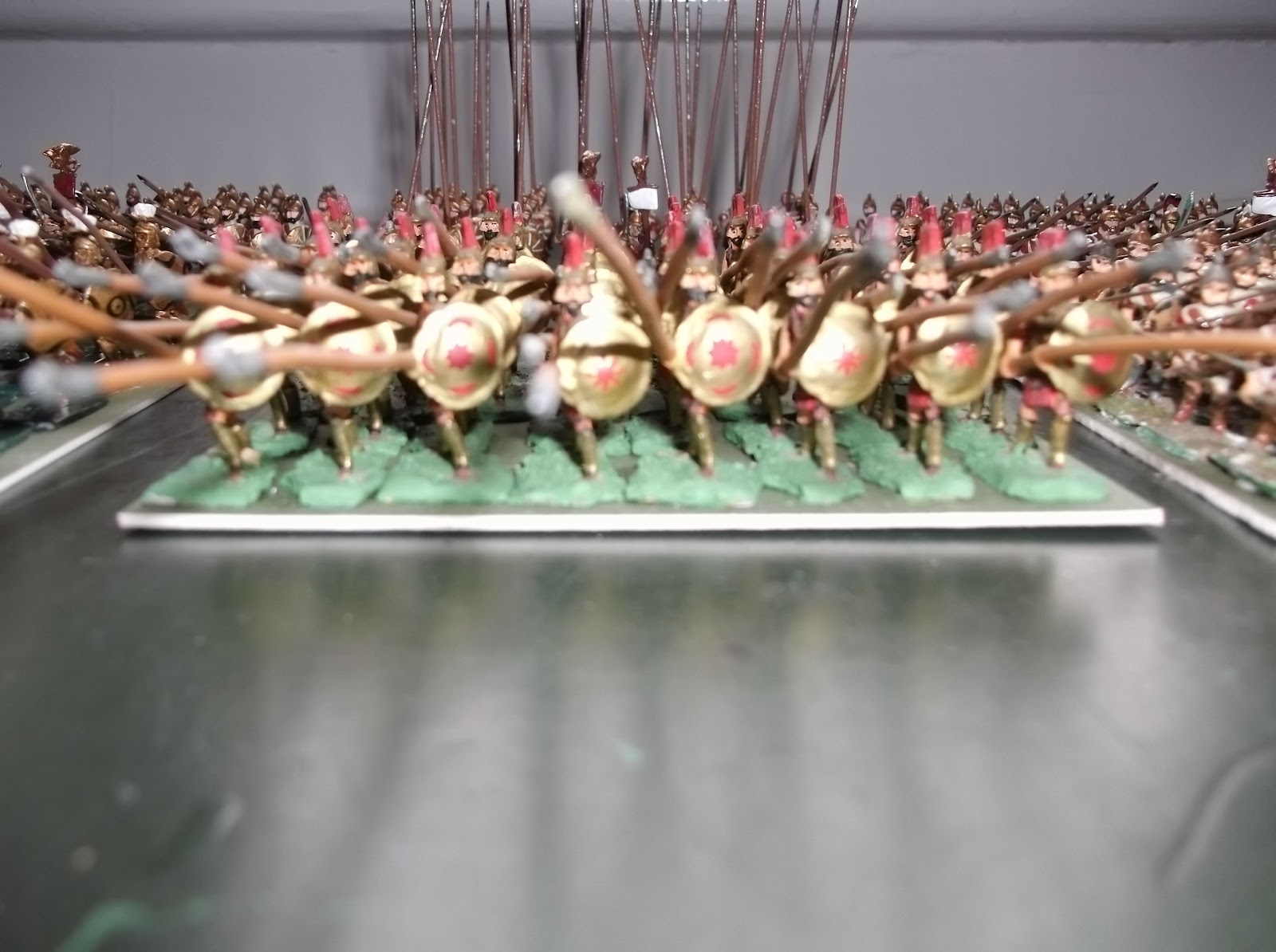
(Pbs Macedonian successor phlangites)
This was another of
our big Christmas battles, fought across a table measuring 13 feet by 6 feet.
On this occasion Kevin White and Paul Jackson joined the usual suspects. Along
with Stephen they commanded the Macedonians.
Clive and I once again took charge of the forces of the Lord of Asia.
In the two previous
large battles – Plataea and the Granicus - I'd felt the Persians had a
reasonable chance of success. For this one, however, I was far from
confident. The make-up of the Persian force was eccentric and seemed to reflect Darius' mounting desperation.
In the Baron De
Bazancourt’s witty 19th Century treatise on fencing “Secrets of
the Sword”, the author observes that, “A gentleman should always be aware of
the fine line that divides those acts which are bold and those that are merely rash”.
Boldness – the Baron counsels sagely - is the province of the decisive and the
brave, rashness stems at best from a lack of confidence in one’s own abilities, and
at worst from cowardice. These words seem particularly applicable when
considering the widely differing temperaments of Alexander and Darius. The
latter, you feel, is forever leaping erratically forward, sword flailing, eyes firmly shut.
(Persian Cavalry - Pbs Dahae horse archers, S Range Assyrian horse archers and two units of Garrison 20mm heavy cavalry)
In the immediate
aftermath of the battle, Stephen gave the following excellent account of the
action:
“For our Christmas
Ancient's big battle Harry laid on an incredible spectacle of 3 elephants, 20
chariots, 464 cavalry and 686 infantry. Once again he generously let
me, and those who arrived with me, command the Macedonians who had won
every historic engagement we had recreated.
This was perhaps the most convincing display of Macedonian might/luck/destiny
so far.
(Garrison 20mm Egyptian cavalry, clash with Greek cavalry from the same maker. In the background is a unit of PBs Thessalians)
As Alexander I feared the unknown effects of
all the scythed chariots and the elephants because we had not faced them before
and I knew that the Persian cavalry were highly manoeuvrable - especially those
horse archers.
I gave Kevin White (Army Padre, attached to Royal Artillery, Albermarle
Barracks) command of the infantry centre - he had to get the phalangites
forward as quickly as he could, use his lights to whittle down the threat from
the chariots and elephants, and keep an eye on the baggage behind him!
Paul Jackson
(Lecturer in War Studies at Birmingham University) said he enjoyed
improvisation, so got the weak left wing whose task was to hang on in there
while the battle was won elsewhere - this he did indomitably which probably
ruined the
Persians best chance of success.
On the right, which had the elite Companions and Hypaspists, I hoped to stay
out of trouble as long as possible and act as a reserve to the big infantry
attack in case the Persian gimmick weapons blunted their assault.
(An overall view of the action. Scythed chariots and Indian elephants rumble forwards, as Greek hoplites preapre to defend the baggage and to the rear Darius looks on with growing nervousness)
This scheme soon had
to be abandoned, however, for a plan that was likely more to the historical
Alexander’s taste.
Finding himself
outflanked by the Persian left wing, Alexander chose to ignore those furthest
to his right and attack diagonally through the joint between the left and centre and head straight for Darius.
The Companions' charge proved unstoppable.
Suffering barely a casualty they rode through everything in their path, leaving
a wake of destruction behind them. They must have appeared to the Persians as
invulnerable and invincible. Since they were barely delayed by their opponents
those enemy units aiming to catch them in the rear and overwhelm them with
weight of numbers simply could not catch up to do so.

(Scythed chariots decide to avoid the spearpoints of the phalanx and swerve off to the side, while in the distance Alexander begins his bold charge towards the Persian king)
The battle was almost a historical recreation. The honourable exception being
the behaviour of the heroic - or desperate – Darius. On seeing the Companions
getting nearer and nearer, the Great King opted not to flee but to join the
nobles in his cavalry and attack the nearest regiment of the phalanx head on.
He died a glorious death and his passing signalled the collapse of the Persian
army.
It felt less like a wargame and more like a statement by the shade of Alexander
himself. The rules, Harry's own, recreated the events of that fateful day from
the uselessness of the scythed chariots to the shock and awe of Alexander at
the head of the Companions. On previous occasions the Companions have taken a
battering and Alexander survived purely by being a jammy so and so, but this
time they were simply the proverbial 'hot knife through butter' and butter does
the knife little harm.

(The Hand of the Fates! Alexander has cut his way through several Persian cavalry units and now just a phalanx of Greek mercenaries stands between him and his prize - the Persian King)
(Elephants on the rampage. They have broken through a phalanx which has also been hit in the flank by Garrison 20mm Assyrian cavalry. Unfortunately for the Persians the scythed chariots are heading in the wrong direction....)
Apart from Paul's
valiant defence on the left the Macedonian generals had little to do than to
let their troops get on with it - frustrating all the abilities of the Persian
generals' expertise and courage.”
(Pbs Thessalians do their bit to hold up the Persian right wing, in this case some S Range assyrian lancers)
Stephen's account
sums up the action very well. As one of the Persian commanders I always felt
there was only a vague chance of winning. That would come if we could get a
spot of luck with the dice and hold the Companions for a move or two which
would have allowed us to make the most of our advantage in numbers. We had
managed this in the Granicus refight and gave the Macedonian a severe mauling.
This time around we were not so fortunate.
One major
problem was the extreme length of our front. At Granicus, on a narrower table,
we had been forced to deploy a reserve. This time around we strung out cavalry
out along the entire table length. When Alexander drove at the point where the
left wing met the centre, he effectively cut a large portion of our army
adrift. With the Companions heading straight for Darius, the Persian left,
which had designs on enveloping the phalangites, was forced instead to break
off from that intention and instead pursue Alexander in a hopeless attempt to save the
king, their progress severely hindered by the decimated Persian units the
Macedonians left in their wake.
Our other problem
was the make-up of our army, which, being nearly all cavalry, had to win the
battle before the phalanx could rumble into contact with our puny centre.
As historically the
scythed chariots had little impact on events. Most veered off to left or right,
avoiding contact with the spear points of the phalanx. The elephants were more
effective, doing major damage to one phalanx before running out of steam, but
they were too few in numbers to have any major effect.
The re-fight gave me
a fresh appreciation of the
brilliance of Alexander's troop dispositions - the second line of hoplites
effectively preventing any outflanking Persian cavalry from attacking the rear
of the advancing phalanx.
(A rare moment of glory for the Persians....Indian elephants smash the phalanx, though the dice indicate they themselves have been severely damaged)
In summary: a wargame that ranked high in terms of
spectacle, but relatively low on the scale of excitement.