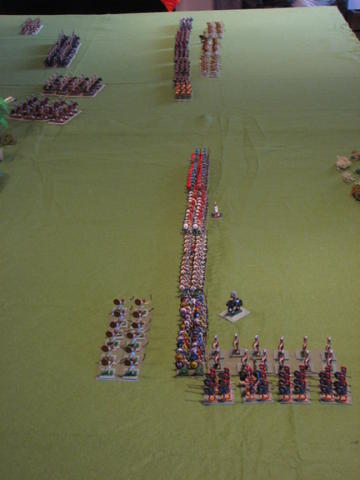
This was
the first of what have become regular Christmas occasions – big battles fought
on a big table, with the regular “generals” often supplemented by visiting
commanders. In many ways this was the type of game that Parum Pugna was
designed for – close to a thousand figures in action and a battle fought
from start to finish in around four hours.
Discussing
the Grant/Dover Coven’s Plataea re-fight on his blog, Ross poses the question
of why the Persians didn’t exploit the open spaces and gaps in the Greek lines
to surround their enemies. It is a real good question, though not one that could be asked
of our version, since the Persian commanders opted for just that tactic –
despatching all their cavalry to gallop off beyond the Asopus Ridge. Some were
tasked with delaying the supporting Spartans and Athenian troops as best they
could, while the horse archers were ordered to peck away at the phalanxes on
the ridge. The bulk of the Persian infantry meanwhile was detailed to make a
frontal assault up the slopes of the Asopus in the hope that sheer weight of
numbers combined with the chipping effect of the light cavalry would eventually
wear down the powerful Spartans.
The Greeks
had little option but to follow the historic order of events, hoping that the
Spartans could hang on until help arrived. Heavily armoured and
well-disciplined they proved less vulnerable to cavalry than the Persians had
hoped, aided greatly by their light troops who performed wonders in protecting
their flanks.
One rule that had an effect on the outcome was using "command points" for the Persians. At the start of their turn the Persians threw 1 AvD for every five units in their command, the resulting score being the number of units that could move that turn. We had used a similar system for Marathon as a means of reflecting the greater cohesion and better command and control of the Greeks. At Plataea the Greeks were clearly not as co-ordinated and decisive as they'd been in that earlier encounter. However, I still felt that their more compact and better trained army gave them an advantage over the polyglot Persians.
Sadly no
detailed account of the action survives, but I have the following scraps from
Stephen Caddy – commander of the Greeks - and myself – who, along with Clive
Norman, commanded the “never victorious” Persians.

Stephen:
Today at Harry's we re-fought a very bloody game of Plataea with 360
Greeks opposed by a whopping 596 Persians. Even the generals were dying on
the field. The exhausted Greeks retook the Asopus ridge but lost all
their lights while 7 out of 12 phalanxes were too battered to continue. Of the three
reinforcement phalanx units one arrived on the first throw of the
dice - the other two did not appear at all. The Persians and their allies were
reduced by the end to a handful of mounted and light infantry units. The
Immortals fought magnificently but proved mortal, the horsemen kept
getting behind the Greek lines, the Helots manfully kept the heavier
troops protected at huge cost and the commanders risked all and paid
the price.
Greeks opposed by a whopping 596 Persians. Even the generals were dying on
the field. The exhausted Greeks retook the Asopus ridge but lost all
their lights while 7 out of 12 phalanxes were too battered to continue. Of the three
reinforcement phalanx units one arrived on the first throw of the
dice - the other two did not appear at all. The Persians and their allies were
reduced by the end to a handful of mounted and light infantry units. The
Immortals fought magnificently but proved mortal, the horsemen kept
getting behind the Greek lines, the Helots manfully kept the heavier
troops protected at huge cost and the commanders risked all and paid
the price.
Me: This
certainly was a bloody encounter with four hours of more or less
continuous violence broken only by a brief pause to munch on some ginger nuts. After much bloodshed and some spectacularly lucky dice throwing by a unit of Assyrian spearmen, the Spartans were driven from the Asopus, before the advancing relief could arrive. Alas for the Persians the vast number of units they had at their disposal and poor command and control (how many 2s can you throw on an AvD?) slowed down all movement and they were unable to reinforce this success, before the Athenians arrived and hammered the depleted units on the ridge. A second wave of Persian troops proved less effective than the first. The toll amongst the generals was fearsome. Mardonius died while attempting to rally some Mede Infantry, Pausanius was cut down by Persian lancers and Aristedes of the Athenians was killed just as the Greeks claimed victory by a stray arrow from some marauding Dahae horsemen.
continuous violence broken only by a brief pause to munch on some ginger nuts. After much bloodshed and some spectacularly lucky dice throwing by a unit of Assyrian spearmen, the Spartans were driven from the Asopus, before the advancing relief could arrive. Alas for the Persians the vast number of units they had at their disposal and poor command and control (how many 2s can you throw on an AvD?) slowed down all movement and they were unable to reinforce this success, before the Athenians arrived and hammered the depleted units on the ridge. A second wave of Persian troops proved less effective than the first. The toll amongst the generals was fearsome. Mardonius died while attempting to rally some Mede Infantry, Pausanius was cut down by Persian lancers and Aristedes of the Athenians was killed just as the Greeks claimed victory by a stray arrow from some marauding Dahae horsemen.

This was a
really exciting game that hung in the balance for much of the day but was
eventually decided by Stephen's decisive use of his hoplites. Any hesitation on
his part – even for a move – would have allowed the Persians to use their
superior firepower to better effect and the outcome might have been different.
That at least is the spin Artebazos will put on things when he gets back to Persepolis....
(And for those of you who missed it - here's an action replay....)