Followers

Showing posts with label Books. Show all posts

Thursday, 31 May 2012

The Battle of Plataea - One

(Theban Mercenary Hoplites - Garrison 20mm)

Xerxes Moves West was supposed to turn into a "campaign without maps" but for some reason or other that didn't happen. Instead I turned to the next part of another long discussed project "Great Wargames of History Refought". Having already done Marathon (based on the scenario in Grant's Ancient Battles for Wargamers) and The Korepsis Pass (From the same author's Wargame Tactics) we moved on to Plataea, which features in Grant's The Ancient Wargame. I tweaked his scenario slightly and bumped up the numbers of troops on both sides.

I'm sure that all ancient wargamers have their favourite writers, I should say here that I have a particular fondness for Peter Green, whose book The Year of Salamis (1970. Reissued  - as The Greco-Persian Wars - by University of California Press in 1998) I also used in compiling the scenario.

The Battle of Plataea 479BC

Despite the troubles King Xerxes’ army suffered at the Battle of Thermopylae (480BC) and the defeat of his navy at Salamis in the same year, Persian forces were still able to occupy Athens.  However, in the autumn, fearful that his lines of communication with his Empire were fatally stretched, Xerxes withdrew half his army East across the Hellespont leaving the other half under his brother-in-law Mardonius to hold Northern Greece, an area that had traditionally been sympathetic to the invaders.

In the spring of 479BC after much debate the unoccupied Greek states resolved to attack Mardonius at his base near the city of Plataea on the border of Attica and Boetia. The army that set forth northwards was made up of contingents from 31 cities including Sparta, Athens and Corinth, around 39,000 strong it was lead by the Spartan Pausanias.

Finding that Mardonius had established a winter camp on the northern bank of the Asopus River the Greeks marched through the pass at Mount Cithaeron and attempted to provoke the Persians into an attack by established themselves on a ridge on the southern side of the river.

The Persian army numbered about 50,000 men of which a fifth were mounted. It included strong a strong contingent of Theban hoplites.

The ridge on which the Greeks were located was too rough for a cavalry attack and so with Mardonius well supplied in his camp a stand-off developed that went on for eleven days. Eventually, after Persian horseman had destroyed a supply train and succeeding in poisoning the only water supply accessible to the Greeks, Pausanias decided to return to the city of Plataea.

A staged night withdrawal was planned with each contingent leaving in turn. Unfortunately due to the traditional arguments that accompanied any joint venture by the Greek states, the retreat was chaotic. When morning came, the Spartan force was split, a phalanx under Amompharates still on the ridge and the rest (including their Tegean allies) on the plain in front of the village of Hysiae. The Athenians, meanwhile were near the Vergutiani Spring to the west of the Spartans and separated from them by about a kilometre of open, flat country. The remainder of the Greek army had arrived at Plataea – six kilometres from the Spartan position - in darkness and set up camp. They arrived late in the battle, piecemeal and apparently in some disorder.

Mardonius, meanwhile, seeing his opponents on open ground at last ordered an immediate attack…..

The Greeks


On eastern edge of Asopus Ridge


Spartan Alpha Phalanx (under Amompharates)

Helot Javelins A

(Spartan helots - Garrison 20mm peltasts - hold the wood on the Spartan right flank. S Range Assyrian horse archers are galloping past)

Near Hysiae


Main body under the command of Pausanius and Euryanax

Spartan Beta Phlanx

Spartan Gamma Phalanx

Spartan Delta Phalanx

Spartan Epsilon Phalanx

Tegean Phalanx

Helot Javelins B

Helot Javelins C

Helot Slingers
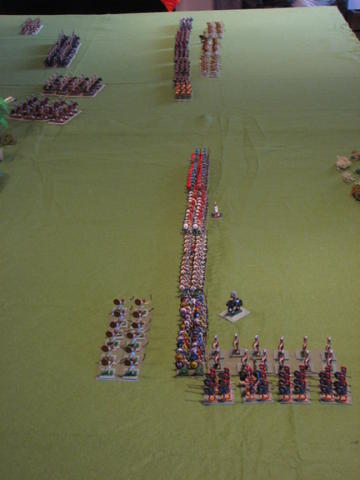

(The Athenians in the foreground, Spartan main body already menaced by Persian cavalry in the back ground)

Near The Vergutiani Spring

Athenians under Aristides

Akamantis Phalanx

Oieneis Phalanx

Kekropis Phalanx

Hippothonteis Phalanx

Antiochis Phalanx

Leontis Phalanx


Parnesian slingers

Phylean archers


All hoplites are in units of 24. Spartans are elite.

All light troops are in units of 12.


Total 288 hoplites, 72 light troops.


Allied Greek States


Hoplite units from Megara, Phliasia and Corinth will appear on the North East table edge on the throw of 18,19 or 20 on a D20 (per unit). Throw at the start of each Greek turn after move one. On a positive score they appear but do not move until the following turn.


(The Persian battle lines at the start of the action. The table was twelve feet long and six deep. The lone Spartan phalanx can be seen on the Asopus ridge.)

The Persians


Left Flank

Under Mardonius


40 Immortals (elite)


40 Ectabana Infantry (Persian)

40 Hamadan Infantry (Mede)


20 Persian Archers

20 Mede Archers


12 Dahae Archers

12 Nineveh Javelins


16 Persian Lancers (close order)

16 Persian Lancers (close order)

16 Assyrian Horse Archers (light)

16 Scythian Horse Archers (light)


Centre


Under Artabazus


40 Indian Spearmen (Auxiliary)

40 Phrygian Axemen (Auxiliary)

40 Assyrian Spearmen (Auxiliary)


20 Ashur Slingers (Auxiliary)

20 Indian Archers (Auxiliary)


12 Assyrian javelins

12 Assyrian archers


(S range Persian Calvalry in action at Plataea)

Right Flank


Under Asopodorus of Thebes


24 Theban Hoplites

24 Phocian Hoplites

24 Locrian Hoplites

24 Malian Hoplites


12 Boeotian javelins

12 Nubian archers

12 Ethiopian archers


16 Thessalanian Cavalry (light)

16 Boeotian Cavalry (light)


40 figure units are close order infantry

20 figure units are close order missile troops

All 12 figure units are light troops

“Medized” Greek hoplites are of lower quality than Athenian and Spartan hoplites.


Totals:


500 infantry

96 Cavalry


Wednesday, 30 May 2012

OPCs

When it comes to military matters it's always good to get in a three-letter acronym (or TLA as they call them in the army). Here are some of the original S range OPC cavalry - Greek on the left, Persian horse archer on the right. They went OOP when Minifigs introduced seperate riders and mounts c.1969. Some examples of the painted Greek cavalry can be seen in Charles Wesencraft's Practical Wargaming.

Friday, 18 May 2012

Coming Attractions...

Charles Grant's The Battle of the Apocryphal Well will be refought next month, giving these veteran S Range Egyptians their first taste of combat in four decades.

The Big Battalions

When I first set out wargaming ancients with veteran figures I organised my hoplites in the manner favoured by Charles Grant and illustrated in The Ancient Wargame. That meant phalanxes of 36-40 figures. As you can see from this photo of these early Garrison 20mm and S Range Spartan units lined up on a ridge such units - even when based 2-deep - cover quite a frontage. The width of the units makes them unwieldy and hard to manoeuvre, which didn't seem quite right to me. So I cut the Hoplite units down in size to 24 figures (an alternative - one that would have looked good - was to base them three deep) while keeping the "Barbarians" in big Grant-style units of 40. Now the Persians are the awkward clumsy ones, while the Greeks are cohesive, their commander able to concentrate his forces more easily.  The photo shows the first ancient battle Clive Norman and I ever fought. Based on a Charles S. Grant scenario it was fought using WRG 3rd edition. A vague recollection is that the Persian commander launched these S range Assyrian charots up the hill at the  Spartans. They were - unsurprisingly - rebuffed, fled the field and - under the WRG morale rules covering irregulars - took most of the rest of the Persians with them.

Thursday, 17 May 2012

Peephole Egyptian

Another figure influenced by the Funckens. This is the Minifigs S range Egyptian light spearman with peek-a-boo shield.

Percentage Dice


There's a lovely moment in an episode of Peep Show when neurotic uber-nerd insurance-drone and live-action role-player Mark Corrigan's internal monologue features the phrase, "I haven't felt this excited since I bought my first set of 20-sided dice". I knew exactly what he meant. These percentage dice, bought at The Model Shop in Blenheim Road, Newcastle have travelled around with me since 1975, and I was very, very excited to get them because - to a thirteen year old-gamer-  owning them seemed like crossing over the threshold into adulthood. Buying them also meant I could use the rules in Don Featherstone's Skirmish Wargaming - which my Mum and Dad had given me for Christmas. And I did use them too, for more games than I can remember, everything from Hadrian's Wall to the Malayan Emergency (with Airfix Confederates as Communist insurgents). If I had to pick an all-time favourite rule set it would be these. The Minifigs S range gladiators were bought around the same time at The Stamp Shop in Linthorpe Road, Middlesbrough and painted with Airfix gloss enamels from the local newsagents. I think there must be a way of adapting the excellent Reiner Knizia card-driven duelling/fencing boardgame En Garde for use in the Circus Maximus. Until then, back in the draw you go lads.

Tuesday, 15 May 2012

Korepsis Pass


Well, now that's quite enough about sex and drugs, now back to the important things

“We were as tortoises mocked by crows” Athenian commander.
The first battle Stephen Caddy and I fought against one another was a re-run of Korepsis Pass, the Charles Grant scenario from “Wargame Tactics”. I was the Athenians, Stephen the Aetolians. Sadly no photos of this historic event remain, so you will have to make do with this snap of some nice Garrison 20mm hoplites who took part in the battle. Both sets were bought painted - the figures with the orange shields from Tony "Warwager" Wade, the ones with white hoplons from a toy soldier shop in Rye in Sussex. Intriguingly when I was photographing these the camera kept giving me the "blink detected" message...As if they were alive or something....
Stephen wrote this stirring account of the action, which appeared on the Old School Wargaming message board.

“As promised, Harry Pearson and I, refought today the historic [in
that it was a chapter in Charles Grant's "Wargame Tactics] engagement
at Korepsis Pass in which the weight of Athenian Hoplites was pitted
against the agility of Aetolian Peltasts. We used Harry's splendid
Greeks - virtually all Garrison 20mm figures and the woods were
equally venerable using largely Britain's trees.

The rules used were Harry's own which are to be found in the 1st
issue of "Battlegames" which will surely (passage deleted due to modesty of blogerator).

The Athenians formed their five units of hoplites in the centre; sent
on their right wing the cavalry, archers and a unit of javelins -
these light infantry looking favourably on the two small woods on
West Hill - to take the aforesaid hill; and on their left this left
two units of slingers to contest the Long Hill, the ridge of which
runs at right angles to the battle lines.

The Aetolians formed only the thinnest of skirmish lines across the
pass - consisting of one unit of slingers and three of javelin-armed
Peltasts: even one of these was destined to fight on the left flank.
On the left flank proper, aiming to contest the hill with the
Athenian cavalry and light troops were two more units of Peltasts
supported by a unit of slingers. The rest of the Aetolian army formed
a powerful right flank in two columns. A unit of Peltasts and another
of archers preceded their two units of Hoplites who advanced onto
Long Hill in a long column intending to form on said Long Hill on the
flank of the advancing Athenians: it was hoped that defending the
hill would give them more chance of holding out against the might of
Athens. Further right the remaining troops [five units of Peltasts
and one each of archers and slingers] were intended to go on a long
outflanking move through the large woods east of Long Hill both to
get behind the Athenians and to support the troops on Long Hill. The
basic Aetolian plan being to overwhelm the Athenian light troops by
weight of numbers thus isolating the heavy infantry who could then be
surrounded and whittled down to exhaustion.

The Athenian right seized the two small woods and their side of West
Hill. The cavalry particularly performed well but so did their
opposite numbers. Once the cavalry were driven off the other Athenian
units were ganged up on until the Aetolians menaced the right of the
hoplite phalanx.

In the centre the Athenian hoplites, after allowing the wings to
advance first, stoically moved forwards. The Aetolians having rushed
forward to gain space to trade for time then fell back hurling more
than insults at the advancing wall of shields.

On the Aetolian right some fierce fighting again went the Aetolian
way because of numbers and their extreme right did indeed spend the
day marching right round to the Athenian rear. One unit of Peltasts
was caught by a charging unit of hoplites but not quite destroyed.
This unit and another [that fought the cavalry] on the opposite side
of the field of Mars were reduced almost to destruction but were
withdrawn and so enabled to stand on the skyline looking like
reinforcements and very pleased with themselves they were.

The Athenian battleline by this point was in some disarray. The
centre unit had borne the brunt of fire from the retreating Aetolian
centre. The right hand unit had been diverted towards the threat from
West Hill and suffered the attentions of the victorious Aetolian
lights from that wing. The two left hand units of Hoplites attacked
the Aetolian Hoplites up the steep slope of Long Hill. The hill
negated their advantage in charging. They never quite managed to gain
purchase on the upper slopes and each time they were pushed back the
Aetolian Hoplites refused to follow up which meant that the Athenians
trying to catch their breath were showered by increasingly bold
Aetolian Peltasts with every missile they could lay their hands on.

This left the Athenians with two other bands of hoplites who were
looking after their general - to be fair they had no real reply to
what was happening to them - they were surrounded but could never
quite reach their more nimble opponents.

There was nothing left but to negotiate terms to withdraw.

Each general had taken some risk in the fighting. Alcibiades the
Athenian had tried to rally the first of the hoplites to break and
had, at some risk to his person, to scamper back to his favourite
unit with which he had advanced. Philocles the Aetolian had joined
the fighting with his hardest pressed unit of hoplites which just
tipped things in their favour.

In conclusion the rules used were justified both by the outcome of
the original battle of Korepsis and by our understanding of the
history of heavy versus light troops in the Ancient times e.g.
Iphicrates [general] Crassus [battle] etc.

The question is "Were the Athenians always on a hiding to nothing or
can they win?" To be fair to them some of the Aetolian units had
outstanding luck with the dice.

We discussed how it might have been any different. Charles Grant
spoke of the action as coming about because of a raid but does not
say who was raiding who. If the Athenians were marching home and only
had to brush aside the Aetolians and reach the other side of the
pass; of if the Aetolians were the raiders and were burdened with
looted cattle and slaves so that the Athenians could choose to stand
their ground it might make for a more even contest. Korepsis Pass as
a straightforward encounter seems to be principally a test of the
rules to see if they achieve what one might expect.

In this Harry's rules certainly passed with flying colours. Nearly 30
units fought to a result in about two hours play.

If the test of Charles Grant's book is 'was a good time had by all'
then it too achieved its aim.”

Here, here to that last sentiment


Phrygian Axemen


These Garrison 20mm Phrygian axemen - which I appear to have painted in subconscious homage to Wasps RFC - are based on an illustrations in Liliane and Fred Funcken's Le Costume et Les Armes des Soldats de Tous le Temps vol 1 (Casterman 1966 - I have all my Funckens in the original French, a vain attempt to convince outsiders that there is a profound intellectual aspect to my hobby). Along with Niels M Saxtorph's Warriors and Weapons of Early Times (Blandford 1972) this book had a profound effect on the design of Ancient figures in the early years of wargaming. Les Higgins/Phoenix Model Developments small range of Ancient Figures for example included an "Anatolian Guard Spearman" (I need another 18 to complete a unit, if you have any) lifted straight from page 27 of Funcken where he stands a few spots along from the inspiration for the Minifig S Range Mede spearman and the Garrison 20mm Persian Standard Bearer. Sadly no manufacturer madethe splendid "chameau de guerre" on the next page - a Bactrian camel complete with shield-lined wooden howdah, which allegedly saw service with the Persians. Phil Barker's WRG guides superceded the Funckens and Saxtorph, which at the time was hailed as progress...